
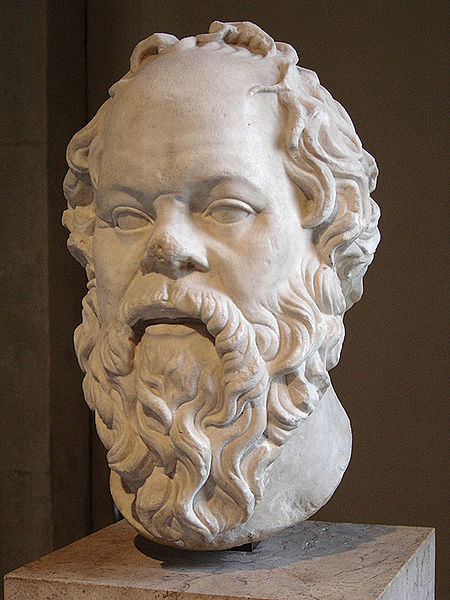
Socrates
•Marble
Roman artwork
•1st Century
•Copy
of Lysippos
•From
4th Century BC
•Original
was bronze
•Louvre
| Homer speaks of the weaving
of the peplos in the Odyssey. In Archaic Greece, the word referred to the
rectangle of cloth commonly worn by women. The Parthenon frieze contained a
relief of Athena carrying a sacred peplos. The peplos was woven at home out
of wool; lengths were woven to suit the size of the wearer. The garment was
created by draping or wrapping the rectangle of cloth around the body and
fastening it with metal fibulae (left), or clasps. These were often worked
with decorative designs or stones. Linen eventually became the fabric of
choice for its flow and coolness, and could be woven to a gauze-like
weight.The Greeks also imported silks from China. Preferring fabrics that
would drape well, they unraveled silk threads from the Chinese goods and
rewove them into softer textures. Vegetable dyes were used, and embroidered
and woven designs decorated borders. Pleating was a popular treatment. |
|
| The Greeks had a range of
garments which were used alone or layered for warmth. The basic element for
both men and women was the chiton, originally a tunic-like garment sewn at
the shoulders and under the arm, but later wrapped around the body and
secured with pins at the shoulders. Variations in the placement of pins and
belting developed into different styles of chiton that are closely related to
the changing aesthetic in the development of Greek art and architecture. |
|
| The Doric Peplos (Archaic
period, to 500 BCE): women wore the chiton fairly closely wrapped on the
body, with a pin at each shoulder. This is pictured as a patterned garment,
probably of wool, and is called the Doric Peplos. |
|
| The Ionic Chiton (550 - 480
BCE, less often from 480 - 300 BCE): both men and women wore this version. It
was fuller, of a lighter weight wool or pleated linen, with a sleeve created
by pinning the opening closed from shoulder to elbow. Women wore it long, and
men both short and long. The Charioteer of Delphi wears a form of Ionic
chiton, with the shoulder seams sewn shut. |
|
| The Doric Chiton ( 400 - 100
BCE): narrower than the Ionic, again fastened with one brooch at the
shoulder, and without sleeves. This was worn by both sexes, and was of wool,
linen or silk. A less ostentatious version than the Ionic, it suited the
attitudes of restraint and moral rectitude prevalent in the late Classical
Period. The chiton was belted by a braided girdle, that could be crossed
under the breast to hold the chiton in place.In the High Classical period the
Doric chiton was fashioned from a wider piece of fabric, the extra height
folded down to cover the torso. This overfold, known as the apotygma, could
then be belted and bloused, such as is seen in the Porch Maidens on the
Erechtheion. |
|