|
1
|
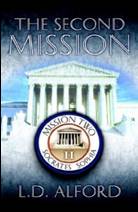
- L.D. Alford
- Author of The Second Mission
- www.lionelalford.com
- www.ldalford.com
|
|
2
|
- 18 written, 6 published, 2 on contract
- The Second Mission – historical fiction
- Centurion – historical fiction
- Aegypt – historical fiction/suspense
- The End of Honor - SiFi
- The Fox’s Honor - SiFi
- A Season of Honor - SiFi
- The Sister of Light/Darkness – 2 on contract
- The Shadow/Warrior of Light/Darkness – 4 in consideration
- The Ghost Ship Chronicles – 5 in consideration
|
|
3
|
- Historical fiction novel with a SiFi driver
- Idea 1994, start 1996, finished 2000
- Published by Xulon in Aug 2003
- Follows Alan Fisher and Sophia
- Time: October 400 BC to October 399
BC
- Location: Athens Greece
- Available here from me and
Watermark Books
|
|
4
|
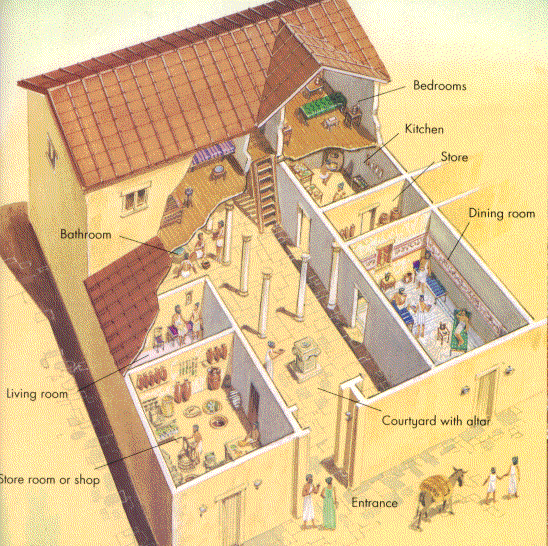
- 1. Novel, characters, history, politics
- 2. Ancient Greece in time and place – 400 BC
- 3. Paganism and the musterium – 400 BC
- 4. Greek life – 400 BC
- 5. Socrates
- 6. The Socratic Dialogs
- 7. The Death of Socrates
- 8. Conclusion
|
|
5
|
- Novel is historical—2+ years of research
- Mainly primary sources in history
- Language, religion, and cultural details
- Suspense driven by historical data
- My question: What would happen if
a modern person was accidentally pulled back into a time mission? Cascading questions:
- What is the most important event in history that future societies would
want to confirm or observe?
- How would they go about it?
|
|
6
|
- As he trudged up the lane, the gate to the house opened and an elderly
man stepped out. He looked about 70-years old and was dressed in a
simple long toga without any decoration. Even his belt was plainer than
the average Athenian’s. In a slightly perturbed manner, the man looked
up and down the street then set out toward Caliban. The old fellow
swaggered with assurance, like a soldier. He threw back his head and
shoulders, and with his bald head, he looked almost like the Marine
sergeants who managed the guards at the classified facilities in the
desert.
|
|
7
|
- Except for his beard, Caliban would have sworn the man could have been
any one of those tough soldiers. As the old man came closer, Caliban
could easily make out his features. The man’s face was homely, the
features large and heavy. His nose was snub and his prominent eyes
stared out from under shaggy eyebrows. The man passed by him unsmiling,
but he did not miss Caliban.
Caliban knew he was noticed and catalogued. The eyes seemed to
collect, analyze, and pierce him to the core. As they passed, Caliban
knew the man must be Socrates.
|
|
8
|
- His deduction was confirmed when the strong steps behind him stopped,
and the man said in a louder than necessary voice, “Be sure Xanthippe
doesn’t mix too little water in her wine.”
- Caliban turned toward him.
- “Ah, you can hear some instructions. Save me at least a meat pastry, my
friend, otherwise, I shall go hungry tonight,” Socrates smiled at him,
then turned and continued down the hill.
|
|
9
|
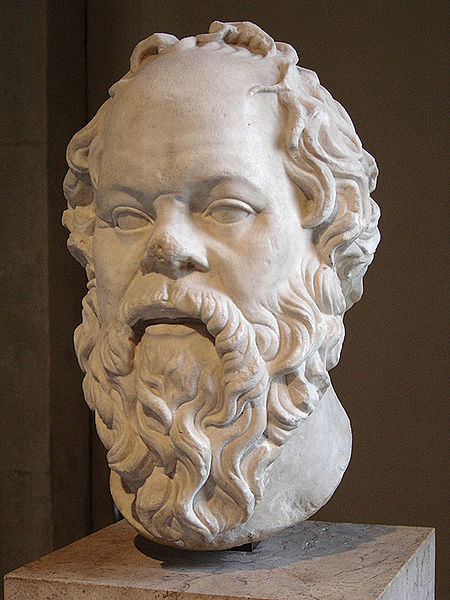
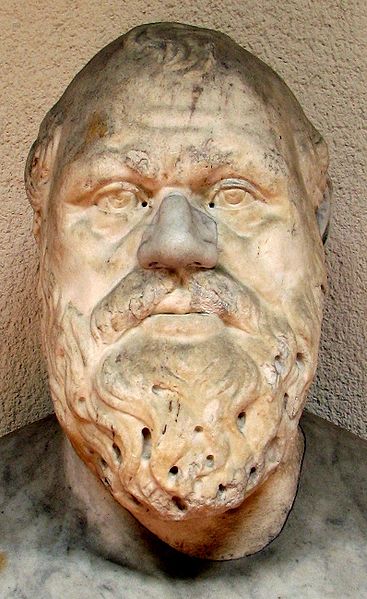
- Marble Roman artwork
- 1st Century
- Copy of Lysippos
- From 4th Century BC
- Original was bronze
- Louvre
|
|
10
|
|
|
11
|
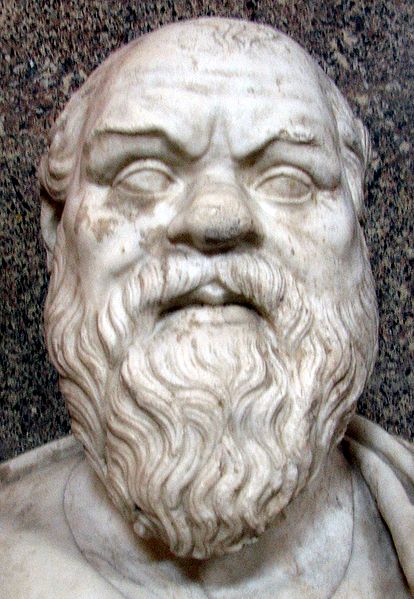
- Museo archeologico
- regionale di Palermo, Italy
|
|
12
|
- Details from 3 contemporary sources:
- Dialogues of Plato
- Dialogues of Xenophon
- Plays of Aristophanes
|
|
13
|
- Aristophanes' play The Clouds
- Portrays Socrates as a clown who teaches his students how to bamboozle
their way out of debt.
- Most of Aristophanes' works are parodies
- My partial retranslation is included
- According to Plato
- Socrates' father was Sophroniscus, a stone mason
- Mother Phaenarete, a midwife
- Characterized as unattractive in appearance and short in stature
|
|
14
|
- Socrates married Xanthippe, who was much younger than he
- She bore for him three sons, Lamprocles, Sophroniscus and Menexenus
|
|
15
|
- In the darkness, a hand on his arm awakened Caliban
- from his deep slumber.
- “Good evening, Sophia’s slave,” said a voice too loud in his ear. “Did
you save me some food?”
- Sleep disconcerted Caliban for a moment, and he almost spoke. He caught
himself and bit off the words with a grunt. He nodded and stood up.
Caliban took the pastries from the shelf behind the hearth and handed
them to Socrates. Almost no light illuminated the room. Caliban heard
the large man sit down on the floor, and Caliban sat back where he had
been sleeping.
|
|
16
|
- Between mouthfuls, Socrates said to him, “Thank you, my friend. I was
famished. You cannot speak, or so I understand, but you are a good
slave. Because it is so late, and I doubt you would understand all the
meaning of my words, I will not define either good or slave to you.”
Caliban could hear the mirth in Socrates’ words though he couldn’t see
his face. “But, you may understand that the words themselves are
illusive without illumination,” Socrates laughed heartily. When he
finished eating, Socrates arose and said, “Now, I must find my way to
bed, friend slave. Xanthippe is a thin woman, but very warm. Be sure you
don’t settle just for one or the other.”
|
|
17
|
- Unclear how he earned a living
- Ancient texts indicate he did not work
- Xenophon's Symposium, Socrates reported saying devotes himself only to
what he regards as the most important art or occupation: discussing
philosophy
- In The Clouds Aristophanes portrays Socrates as accepting payment for
teaching and running a sophist school with Chaerephon
- Plato's Apology and Symposium and in Xenophon's accounts, Socrates
explicitly denies accepting payment for teaching
|
|
18
|
- In Apology Socrates cites his poverty as proof he is not a teacher
- Timon of Phlius and later sources state Socrates took over the
profession of stonemasonry from his father
- Tradition in antiquity, not credited by modern scholarship, that
Socrates crafted the statues of the Three Graces, which stood near the
Acropolis until the second century AD.
|
|
19
|
- Plato's dialogues refer to Socrates' military service
- Socrates says he served in the Athenian army during three campaigns: at
Potidaea (432) , Amphipolis (422) , and Delium (424)
- In Symposium Alcibiades describes Socrates' valor in the battles of
Potidaea and Delium
- Recounts how Socrates saved his life in former battle
- Socrates' exceptional service at Delium mentioned in the Laches by
General after whom dialogue is named
- In Apology, Socrates compares his military service to his courtroom
troubles, he says anyone on the jury who thinks he ought to retreat
from philosophy must also think soldiers should retreat when it looks
like they will be killed in battle.
|
|
20
|
- In 406 he was a member of the dikasterion
- His deme the Antiochis held the Prytany on the day the Generals of the Battle
of Arginusae (who abandoned the slain and the survivors of foundered
ships to pursue the defeated Spartan navy) were discussed
- Socrates was the Epistates (overseeer) and resisted the
unconstitutional demand for a collective trial to establish the guilt
of all eight Generals
- Refused to be cowed by threats of impeachment and imprisonment and
blocked the vote until his Prytany ended the next day, whereupon six of
Generals were condemned to death.
|
|
21
|
- In 404 the Thirty Tyrants
- Sought to ensure the loyalty of those opposed to them by making them
complicit in their activities
- Socrates and four others were ordered to bring a certain Leon of
Salamis from his home for unjust execution
- Socrates quietly refused, his death averted only by the overthrow of
the Tyrants soon afterwards
|
|
22
|
- “Come, Caliban,” said Sophia, “It’s time to take you to Crito’s house.”
- As he crossed the courtyard, Caliban spotted Socrates immediately. He
still wore a plain toga without a belt or decoration. His feet were
bare, and almost every man in the room surrounded him. In the inner
circle stood seven older men. They looked as least as old as Socrates,
and they leaned on the stone and wooden benches. In the outer circle
were a few middle-aged men and many men in their twenties and thirties.
These stood listening quietly.
|
|
23
|
- With the jar of wine in both hands, Caliban stood outside the circles,
but Socrates noticed him almost immediately. He gestured toward the
slave and in an overloud voice said, “There is my borrowed slave. Come
Caliban, fill my cup and lubricate my speech.”
- Caliban stepped through the circle and filled the proffered cup.
- “Now, here is a man doubly cursed and doubly blessed,” he still pointed
at Caliban.
- “How is that, Socrates?” someone took the challenge.
|
|
24
|
- “Why, Caliban is mute; he cannot converse as a man. His greatest
thoughts will be hidden forever from us. He will never command respect
for his oration. Indeed, how can we know he is a man except through his
actions and his form? In these things he is cursed.”
- “But, how is he blessed?”
- “Caliban can take any secret and not even torture will force it from
him. That is his first blessing. The second is this, by foolish words,
he cannot betray his lack of wisdom. And, in this, we must assume, he is
wise.
|
|
25
|
- Most men prove they are not wise through their own words. Caliban cannot
prove he is not wise, therefore, he must be wise.”
- “But, he is only a foolish slave, Socrates.”
- “Phaedo, how can you tell a man is wise?”
- “Of course by his words, Socrates.”
- “Do you value a man who speaks constantly or one who speaks little?”
- “If a man speaks constantly but his words are wise.”
- “Do you know a man like that?” Socrates chuckled.
- “I never met one.”
|
|
26
|
- “Wisdom of Socrates, you say Phaedo. I can prove only one man’s wisdom
here and that is Caliban’s. I myself know I am not wise, but Chaerephon,
rest his soul, asked the god at Delphi who was the wisest man. You all
know the answer of the god. Chaerephon was a man of wisdom for both
asking the question and for bringing the answer to me. That answer gave
feet to my thoughts and direction to my soul. Chaerephon was a Democrat
and a wise man. The two are not incompatible.”
|
|
27
|
- “Then,” said Phaedo, “What of the priests; those who serve the gods?
Some are here. Certainly, they are wise.”
- “Very good, Phaedo. We should assume the priests are wise. But can they
be wise only because they serve the gods. For don’t all of us serve the
gods? Is that not our purpose? So then, what characteristic makes them
wise?”
|
|
28
|
- “Surely they are more pious than other men, for their life revolves
around service to the gods, and that service is what we call pious.”
- “Good, Phaedo, you have given a name to the thing we seek. If we can
determine, in your view, what is pious, then we have found wisdom?”
|
|
29
|
|
|
30
|
- Argument from Euthyphro
- Context a symposium given by Crito, friend of Socrates
- Reuse of arguments/dialogues
|
|
31
|
- Socrates and his following stopped suddenly and Socrates said, “How now,
Hermogenes and Cratylus. You appear to be rushing for knowledge. Don’t
let us stand in your way.” He made an expansive gesture for them to
precede him through the gate.
- Hermogenes spoke right at Socrates’ ear but his voice carried far, “I
should explain to you, Socrates, our friend Cratylus and I are
conversing about names. He says they are natural and not made up. He
says they are not elements of human speech that men agree to use, but
there is a truth or correctness in them. A truth that is the same for
Hellenes as for barbarians.”
|
|
32
|
- Platonic dialog concerning the origin of names of things in language
- Question: whether names are "conventional" or
"natural", that is, whether language is a system of arbitrary
signs or whether words have an intrinsic relation to the things they
signify.
- Cratylus became one of the earliest philosophical texts of the Classical
Greek period to deal with matters of etymology and linguistics.
|
|
33
|
- Euthyphro greeted Socrates like a long-lost friend, “Why have you left
the Lyceum, Socrates? And what are you doing on the Porch of the King
Archon? Surely you cannot be involved in a suit before the King, like
myself?”
- Socrates sat beside Euthyphro in the shade on the steps, “Not in a suit,
Euthyphro; impeachment is the word the Athenians use.” Caliban sat just
behind Socrates, and the other men arranged themselves on the steps.
|
|
34
|
- Euthyphro gestured haphazardly, “What! I suppose someone is prosecuting
you, for I cannot believe that you are the prosecutor of another.”
- “Certainly not.”
- “Then someone else is prosecuting you?”
- “Yes.”
- “And who is he?”
- “A young man who is little known, Euthyphro, and I hardly know him. His
name is Meletus, and he is of the deme of Pitthis. Perhaps you may
remember his appearance. He has a beak, and long straight hair, and a
beard that is ill grown.” The men laughed.
|
|
35
|
- Euthyphro shrugged, “No, I do not remember him, Socrates. But what is
the charge he brings against you?”
- “What is the charge? Well, a very serious charge that shows a good deal
of character in the young man, and for which he is certainly not to be
despised. He says he knows how the youth are corrupted and who are their
corruptors. I fancy he must be a wise man, and since I am the reverse of
a wise man, he found me out, and is going to accuse me of corrupting his
young friends. And of this our mother, the State, is to be the judge.
|
|
36
|
- Of all our political men, he is the only one who seems to begin in the
right way, with the cultivation of virtue in youth. Like a good
husbandman, he makes the young shoots his first care, and clears away
those who are the destroyers of them. This is only the first step—he
will afterwards attend to the elder branches, and if he goes on as he
has begun, he will be a very great public benefactor.”
- “I hope he may, but I fear, Socrates, the opposite will turn out to be
the truth. My opinion is that in attacking you, he simply aims a blow at
the foundation of the State. But in what way does he say that you
corrupt the young?”
|
|
37
|
- Plato’s dialog concerning piety and wisdom
- Euthyphro, a man known for claiming to be a religious expert
- They attempt to pinpoint a definition for piety
- Since I gave the argument during Crito’s symposia, I just give the
context here
- Argument is the definition of piety
- Point is Socrates makes Euthyphro look like a fool
- Bigger point is the charge of impiety is one Socrates must defend in the
Apology
|
|
38
|
- The chief clerk stepped to the center of the raised area. He opened a
scroll and read, “‘It is so sworn on this day, in the name of the great
god of Athinai: Socrates is a public offender in that he does not
recognize the gods recognized by the state of Athinai, but introduces
new demoniacal beings. He has also offended by corrupting the youth of
Athinai.’ The charge is brought by Anytus, Meletus, Lycon, and Phormio.”
|
|
39
|
- Socrates’ defense of himself before the dikasterion
- Recorded by Plato and Xenophon
- Plato’s account is much more detailed
- We will see this in much greater detail next time
|
|
40
|
- Caliban lay half awake on dank stones. He heard Socrates’ snores
comfortably above him in the darkness. Socrates was still alive. Alive
until the Delos offering ship returned to Athinai. The priests crowned
the stern of the ship the day before Socrates’ trial. Already nearly a
month passed since the ship left with the thank offering to Apollo.
Until the ship returned to port, Athinai lived in a “holy season” where
no human life could be taken. Soon the ship would return, and with it
would come Socrates’ executioners.
|
|
41
|
- As the prison grew slightly brighter with the false dawn, Caliban was
alarmed to note another shadow in the room. He remained silent. Had
Anytus sent an early executioner? After a while, he recognized the
craggy features of Crito, Socrates’ old friend. Socrates rolled over in
his sleep; the scrape of his chains stridently filled the small dark
room. Caliban heard the sound of the fetters, then Socrates’ voice,
cheerful though low, “Why have you come at this hour, Crito? It must be
quite early.”
|
|
42
|
- Crito’s voice flowed out of the darkness, “Yes, it is.”
- Socrates stretched, “What is the exact time?”
- “The dawn is breaking.”
- “I wonder the keeper of the prison would let you in.”
- “He knows me because I come often, Socrates; moreover, I have done him a
kindness.”
|
|
43
|
- “Yes: the meaning is only too clear. But, O! My beloved Socrates, let me
entreat you once more to take my advice and escape. If you die I shall
not only lose a friend who can never be replaced, but there is a second
evil. People who do not know you and me will believe I might have saved
you if I were willing to give money, but that I did not care. Now, can
there be a worse disgrace than this that I should be thought to value
money over the life of a friend? Many will not be persuaded that I
wanted you to escape, yet you refused.”
|
|
44
|
- Attempt by Crito to have Socrates (in prison) escape Athens and
therefore save his life
- Conversation regarding justice (dikē), injustice (adikia), and the
appropriate response to injustice
- Socrates states that injustice may not be answered with injustice, and
refuses Crito's offer to finance his escape from prison
- This dialogue contains an ancient statement of the social contract
theory of government
- Socrates takes the opportunity to deliver the message that the state
and the justice of the state is more important than his life
|
|
45
|
- Socrates stared at each of the men, giving every one a comfortable
smile, “Where is Plato?”
- Phaedo, sitting as usual at Socrates’ feet, answered, “Plato is ill. He
begged me to bring him your every word so he might remember this day for
Athinai. I think he could not bear to see your death. He believes he
loves you more than any of us.”
|
|
46
|
- Socrates only smiled at him. Then he sat up on the couch and began to
bend and massage his leg where the chains had bound him, “How singular
is this thing called pleasure, and how curiously related to pain, its
opposite. They never come to a man at the same time, yet a man who
pursues one is generally compelled to accept the other. They are two,
yet they grow together out of one stem. I cannot but think if Aesop had
noticed them, he would have made a fable about a god trying to reconcile
their strife. When the god could not, he fastened them together. This is
the reason when one comes the other follows, as I find in my own case
pleasure comes following after the pain in my leg that was caused by the
chain.”
|
|
47
|
- The death of Socrates
- Socrates discusses the nature of the afterlife on his last day before
being executed by drinking Hemlock poison. This dialogue is narrated by
Phaedo to Echecrates
- Dialectic with a group of Socrates' friends, including the Thebans Cebes
and Simmias, Socrates explores various arguments for the soul's
immortality in order to show that there is an afterlife in which the
soul will dwell following death
|
|
48
|
- Socrates’ 4 arguments for immortality of the soul
- The Opposites Argument or "Cyclical argument" explains that
as the Forms are eternal and unchanging, and as the soul always brings
life, then it must not die, and is necessarily
"imperishable". As the body is mortal and is subject to
physical death, the soul must be its indestructible opposite. Plato
then suggests the analogy of fire and cold. If the form of cold is
imperishable, and fire, its opposite, was within close proximity, it
would have to withdraw intact as does the soul during death. This could
be likened to the idea of the opposite charges of magnets.
|
|
49
|
- Socrates’ 4 arguments for immortality of the soul
- The Theory of Recollection explains that we possess some non-empirical
knowledge (e.g. The Form of Equality) at birth, implying the soul
existed before birth to carry that knowledge. Another account of the
theory is found in Plato's Meno, although in that case Socrates implies
anamnesis (previous knowledge of everything) whereas he is not so bold
in Phaedo.
- The Affinity Argument explains that invisible, immortal, and
incorporeal things are different from visible, mortal, and corporeal
things. Our soul is of the former, while our body is of the latter, so
when our bodies die and decay, our soul will continue to live.
|
|
50
|
- Socrates’ 4 arguments for immortality of the soul
- The Argument from Form of Life explains that the Forms, incorporeal and
static entities, are the cause of all things in the world, and all
things participate in Forms. For example, beautiful things participate
in the Form of Beauty; the number four participates in the Form of the
Even, etc. The soul, by its very nature, participates in the Form of
Life, which would mean the soul could never die.
|
|
51
|
- Physical description of Socrates
- Socrates’ life
- The dialogs in their context
|
|
52
|
- I won’t be here next week—week after
- The Death of Socrates
|

 Notes
Notes